
Transpacific Rate Surge: Market Recovery or Volatility?

Updated: Jul 23

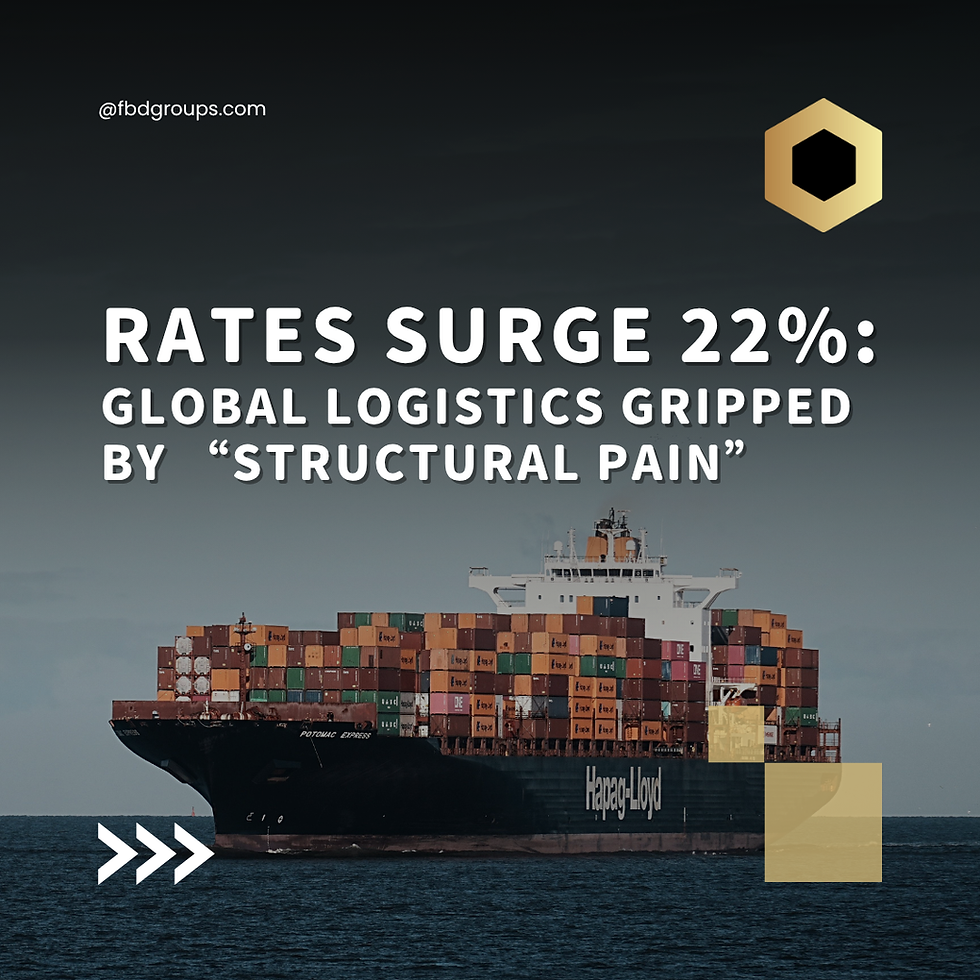
As we enter April 2026, the transpacific route is witnessing a classic 'structural misalignment': maritime rates are trending upward, defying the typical seasonal downturn.
According to data released on April 7th by the Freightos Baltic Index (FBX), the leading global containerized freight index, maritime rates from Asia to the U.S. West Coast have increased by approximately 11% month-over-month (MoM). Meanwhile, shipping rates from Asia to the U.S. East Coast saw a MoM rise of about 5%.
Despite these fluctuations, underlying market conditions remain largely stagnant. Freightos had forecasted as early as January that global container shipping demand would contract by approximately 10% year-over-year (YoY) in 2026. The fact that prices are surging while demand continues to soften indicates that this rate of hike is decoupled from actual market consumption.
Understanding the Surge: A Shift Driven by Costs Rather Than Volume
The current surge in maritime rates does not stem from an organic recovery in market demand. Instead, it is the result of soaring fuel prices and rising insurance premiums, which are among the hard operating costs that have forced prices upward.
First, fuel costs have seen significant volatility due to the Iran War that broke out in February. Brent crude prices peaked during this period while the price of Singapore jet fuel has doubled since the onset of the conflict. This surge in energy prices has forced shipping giants such as Maersk to reintegrate fuel surcharges (BAF) into their pricing structures.
The second factor is the intermittent blockage of effective capacity. Even though the global fleet continues to expand and faces a general overcapacity, the conflict has hindered the operation of numerous vessels. According to a report by Reuters, more than 100 container ships were stranded near the Strait of Hormuz at one point since the conflict began. These forced rerouting have not only extended transit times and inflated operating costs but have also indirectly hampered the drayage efficiency of destination port and the overall reliability of first-mile transportation timelines.
Two-week Ceasefire in Iran as Shipping Supply Chain Remain Cautiously Monitored
Despite the short-term ceasefire reached between the United States and Iran, the shipping market does not equate this situation with a signal of full-scale recovery.
Observations from Bloomberg indicate that while the ceasefire agreement allows vessels to transit in coordination with Iranian Armed Forces, the Strait of Hormuz remains as restricted, conditional, and controlled. Sultan Al Jaber, the CEO of Abu Dhabi National Oil Company (ADNOC), explicitly stated that the strait is not truly open at this time.
Currently, nearly 2,000 international trade vessels and approximately 20,000 seafarers in the Gulf region remain in a state of extreme caution. As noted by Lars Jensen, CEO of Vespucci Maritime, the current ceasefire is viewed merely as an escape window. Ocean carriers are focused on evacuating stranded vessels from the Gulf rather than risking new vessels into the area. Peter Sand, Chief Analyst at Xeneta, also pointed out that the two-week window is too short for operators to restore regular sailing schedules.
Comments