
US Plug-In Solar Boom: Multiple States Ease Rules as Demand Surges

Updated: Aug 20
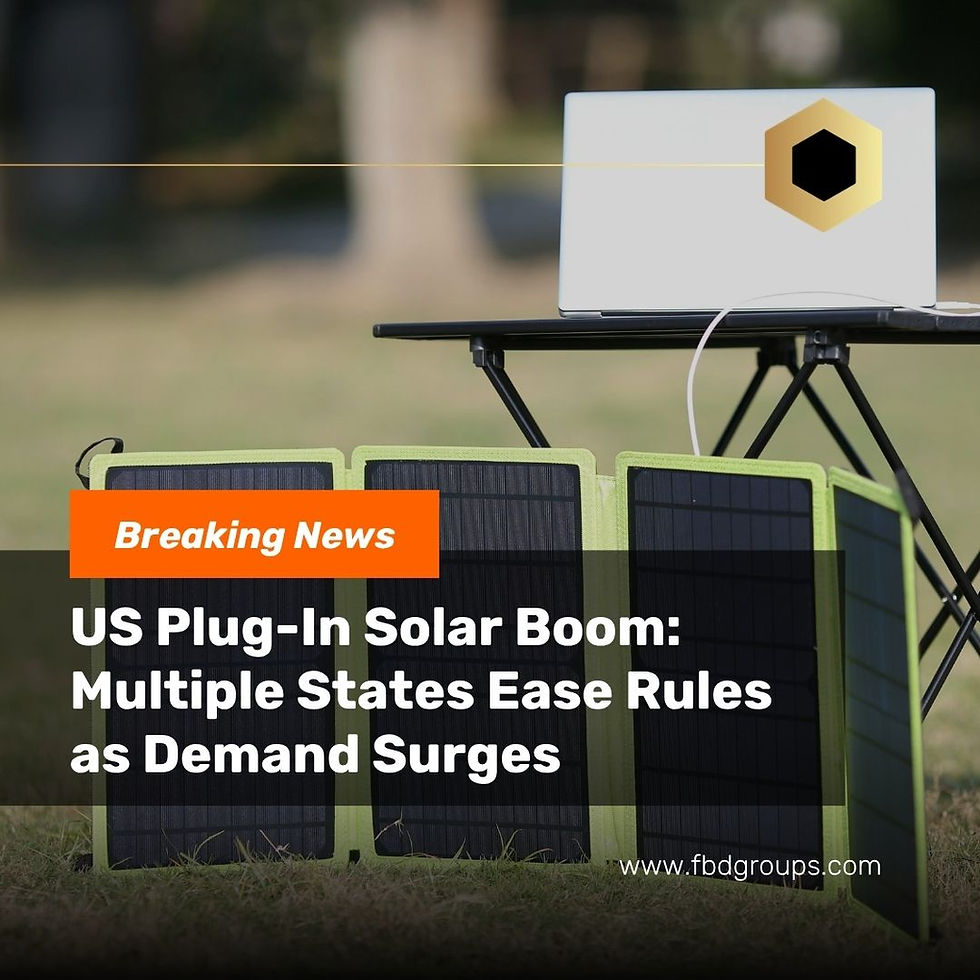
Are new opportunities emerging in the U.S. residential solar market?
Following the expiration of the federal residential clean energy credit, homeowners completing residential solar installations can no longer claim the 30% federal tax credit.
Higher purchasing costs for residential consumers would naturally reduce demand for residential solar installations.
However, multiple U.S. states are now easing regulatory restrictions on the installation and grid connection of plug-in solar panels. This policy shift aims to expand solar energy access to renters, apartment dwellers, and households unable to install traditional rooftop solar systems.
Looking ahead, lower-cost, easy-to-install small-scale solar systems that can plug directly into household circuits may become a new source of consumer demand, creating potential growth opportunities for solar modules, inverters, and energy storage equipment.
What Is a Plug-In Solar System?
A plug-in solar system—commonly referred to as a balcony solar system—typically consists of solar panels, a microinverter, power cables, and safety control devices.
Residents can place these systems on balconies, patios, or other sunny locations and connect them directly to a standard household electrical outlet. Small-scale systems that comply with state statutory requirements bypass the traditional grid-interconnection applications and lengthy approval processes required for conventional rooftop solar projects.
Some states have also begun considering whether to include small commercial users.

Which U.S. States Are Easing Policies for Plug-In Solar Panels?
As of August 2026, Utah, Maine, Vermont, New Hampshire, and Virginia have enacted dedicated legislation that categorizes small-scale plug-in solar systems separately from traditional rooftop photovoltaics, effectively eliminating or streamlining preliminary permitting processes.
Utah:
Utah was among the first states to establish dedicated rules for plug-in solar devices in 2025. Under these rules, equipment qualifies if it carries relevant safety certifications, has a maximum power output not exceeding 1,200 watts, and includes automatic power shutdown capabilities during utility outages.
Maine:
Maine’s governor signed legislation into law on April 6, 2026. The law allows each electrical service address to install plug-in solar or battery storage devices with a total output of up to 420 watts. Systems exceeding 420 watts but capped at 1,200 watts must be installed by a Maine-licensed electrician and connected to a dedicated circuit with an isolated outlet. Products must also comply with UL 3700, equivalent safety standards, or Maine’s adopted electrical codes.
Colorado:
Colorado’s corresponding legislation is scheduled to take effect on August 12, 2026. The new law restricts electric utilities from requiring prior approval applications from residents and prohibits landlords and homeowners associations (HOAs) from banning resident installations.
Virginia:
Virginia’s regulations will take effect on January 1, 2027, capping capacity at 1,200 watts per household. Products outputting 391 watts or less via an outlet are exempt from certain household wiring and main panel upgrade requirements. Users are still required to submit a simplified notification to their utility post-installation, and landlords are prohibited from blocking eligible tenants from installing external units.
California:
California’s bill remains under review by the State Assembly Appropriations Committee. Under its current draft, maximum AC output per household is capped at 1,200 watts, and products must comply with National Electrical Code (NEC) and California Electrical Code standards while securing certification from a Nationally Recognized Testing Laboratory (NRTL).
New York:
The New York State Legislature passed the SUNNY Act in May 2026, which currently awaits the Governor's signature. The legislation intends to exempt qualifying plug-in solar devices from standard interconnection and net metering procedures.
New Jersey:
In New Jersey, the Garden State Balcony Solar Act passed both houses of the state legislature on June 30, 2026, though it has not yet been signed into law by the Governor.

Business and Market Impacts of U.S. Clean Energy Policy Shifts
Affordable, user-friendly, small-scale solar systems are likely to generate strong interest among households that were previously unable or unwilling to invest in full-scale rooftop installations. Solar panel suppliers could gain a new group of potential customers while simultaneously requiring adjustments to product design, certification strategy, and sales models.
For instance, because states like Maine and Virginia enforce tiered regulatory requirements based on wattage capacity, suppliers will need to tailor their product offerings to conform to individual state rules.
Additionally, as plug-in systems connect into standard home electrical circuits, consumer needs extend beyond solar panels alone. Buyers will require bundled hardware including inverters, cables and plugs, safety disconnect switches, mounting brackets, and clear user documentation.
Collaborating with other solar-related businesses to bundle these components into ready-to-sell packages could be a viable strategy.
However, the U.S. market currently lacks a unified national standard for plug-in solar. Allowable power limits, wiring methods, installation conditions, and product certification requirements vary significantly across state lines. Furthermore, legislation in New York, New Jersey, and California has not been fully enacted, indicating that the market remains in its nascent stage.
Suppliers are advised to initially target states where legislation has already taken effect and regulations are well-defined, strategically evaluating consumer demand and distribution channels in those specific markets.
Finally, as small-scale solar components, microinverters, and residential energy storage systems enter the U.S. market, businesses must proactively verify compliance with dangerous goods transport regulations and U.S. regulatory requirements.

FBD GROUPS specializes in dangerous goods and the secure movement of goods across borders in the U.S., providing integrated logistics solutions for electrical products, batteries, new energy products, and transportation. We help businesses enter the U.S. market more securely and support their long-term growth across North America.


Comments